Risk Status Terminology (On-Track, At-Risk, Off-Track)
Last updated: May 8, 2026
V1.1
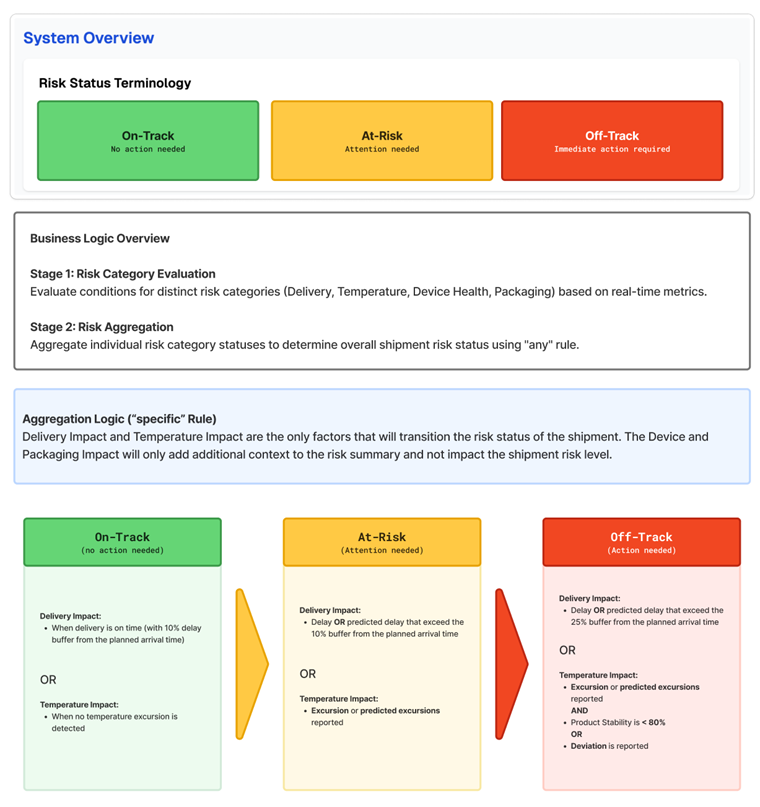
System Overview
Your shipment’s risk status helps you quickly see how things are going in real time.
Each shipment is labeled as one of three statuses:
🟢 On-Track: Everything looks good — no action needed.
🟡 At-Risk: Something may need attention soon.
🔴 Off-Track: Immediate action is required to prevent or address an issue.
How the System Works
The system constantly monitors several key factors that can affect your shipment.
It does this in two main steps:
1. Evaluating Each Risk Category
Each category is reviewed based on real-time data.
For example:
Delivery checks for delays or predicted late arrivals.
Temperature checks for any excursions or readings outside your set range.
Device Health and Packaging provide supporting details about the shipment environment.
2. Calculating Overall Status
After evaluation, the system assigns one overall status.
Important:
Only Delivery and Temperature can change the shipment status
Device and Packaging do not impact the overall status
Understanding Temperature Risk (Excursion vs Deviation)
Temperature risk is evaluated in two ways:
Excursion → Temperature moved outside the allowed shipping range
Deviation → Product may be impacted because it spent too long in certain temperature conditions
👉 You can have an excursion without a deviation
👉 A deviation indicates higher severity and potential product impact
What Each Status Means
🟢 On-Track (No Action Needed)
Delivery: Shipment is on time (within 10% of the planned arrival window).
Temperature: No temperature excursions detected.
🟡 At-Risk (Attention Needed)
Delivery: There’s a delay or predicted delay beyond the 10% buffer.
Temperature: A temperature excursion or predicted excursion has been detected.
👉 At this stage:
The shipment has left ideal conditions
But product impact is not yet confirmed
🔴 Off-Track (Immediate Action Needed)
Delivery: Delay or predicted delay exceeds the 25% buffer.
Temperature: Excursion or predicted excursion detected, and either
Product stability is 80% or lower, or
A deviation has been reported.
👉 At this stage:
There is high confidence of product risk or impact
Immediate action is recommended
Why Deviation Matters More Than Excursion
Excursion tells you something went wrong operationally
Deviation tells you the product may be affected
👉 This is why:
Excursions trigger At-Risk
Deviations (or low stability) escalate to Off-Track
In Summary
Delivery + Temperature drive shipment risk status
Excursions = early warning
Deviations = confirmed product risk
The system flags issues early so you can act before they impact product quality.
Learn More
For a deeper explanation of temperature risk:
→ See: Deviation vs Excursion: What’s the Difference?
Quick Tip
When reviewing a shipment:
Start with the status (On-Track / At-Risk / Off-Track)
For a high-level explanation of how excursions and deviations impact shipment risk status, see: Risk Status Terminology
Check if there is an excursion (early signal)
Confirm if a deviation exists (product impact)
In Summary
Your Delivery and Temperature metrics drive the shipment’s overall risk status.
If either moves out of range, the system flags it — giving you an early warning to take action before a problem occurs.